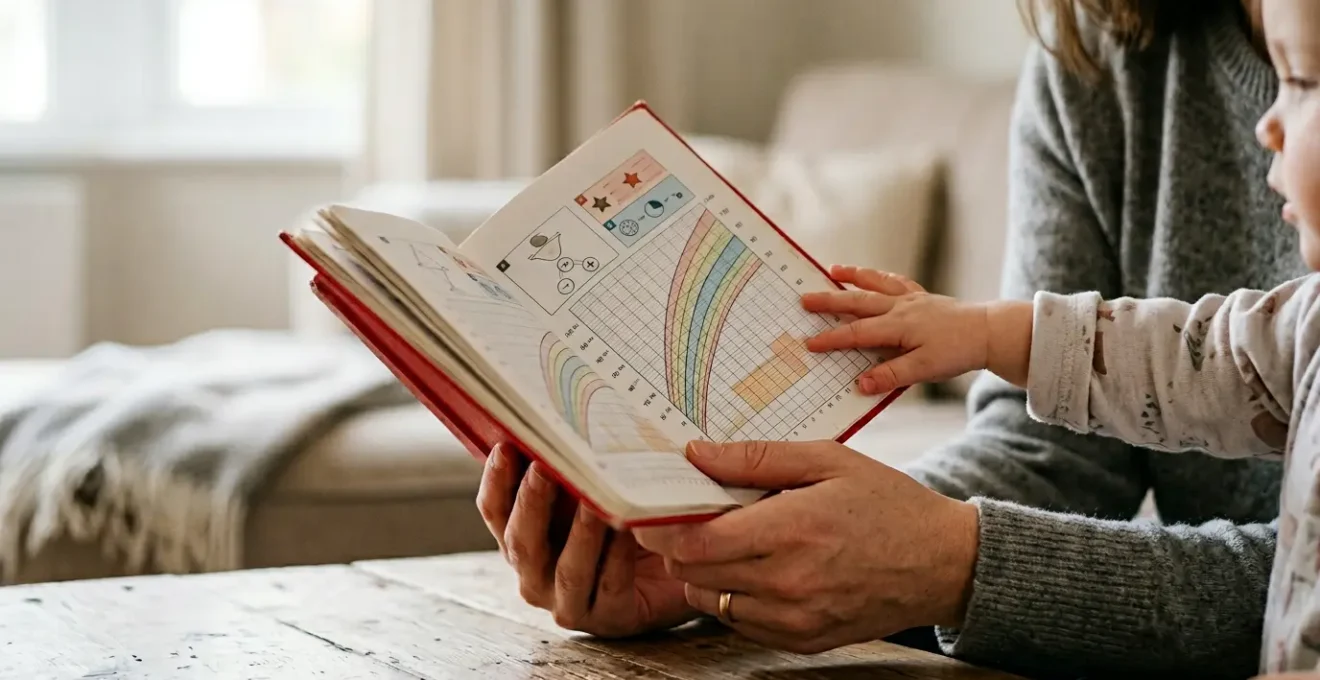
Your child’s Red Book is more than a record of the past; it’s your most powerful tool for confident, evidence-based advocacy in their developmental journey.
- Transform natural parental worry into structured, actionable observations that healthcare professionals can use.
- Learn how to document specific examples and behaviours that can lead to faster access to support services like speech therapy.
Recommendation: Start today. Use the notes section of your Red Book not just for tracking milestones, but to build a rich developmental narrative that empowers both you and your child.
As a Health Visitor, I know the feeling well. You’re handed the Personal Child Health Record—that little « Red Book »—and it feels both precious and weighty. It’s the first official chapter of your child’s story, but as the pages for the 9-12 month and 2-year development checks loom, it can also become a source of anxiety. You scan the milestone charts, compare your child to others, and a quiet worry can begin to grow. Is their babbling on track? Should they be walking by now? Every parent has been there.
The common advice, « don’t worry, every child develops at their own pace, » is true, but it can feel dismissive when you’re looking for concrete answers. Many parents believe the Red Book is primarily for tracking vaccinations and plotting height and weight on a chart. But what if its true purpose was something far more powerful? What if, instead of being a source of anxiety, the Red Book could become your greatest tool for transforming that worry into confidence?
This guide is designed to show you exactly that. We’re going to shift the perspective from passively tracking milestones to proactively documenting your child’s unique journey. This isn’t about passing or failing a test; it’s about learning to become an expert observer and a confident partner in your child’s health. You have a unique insight into your child that is invaluable. This guide will help you structure that insight, creating a clear and detailed picture that will make your conversations with Health Visitors and GPs more productive and less stressful.
By following the advice in this guide, you will learn how to use your Red Book to its full potential. We’ll explore how to interpret developmental milestones, when to seek specific support, and how to build a strong evidence base for any concerns you may have, ensuring you are always your child’s most effective advocate.
Summary: Your Guide to the Red Book and Developmental Checks
- Why Missing One Milestone at 12 Months Is Rarely a Cause for Panic?
- How to Access NHS Speech Therapy Before the School Start Date?
- Walking Late: When Should You worry About Gross Motor Delays?
- Why Are the Orthoptist Checks at Reception Year So Critical for Learning?
- Health Visitor vs GP: Who Should You Call for Developmental Concerns?
- The ‘Watch and Wait’ Approach: Why Do Doctors Delay Diagnosis Until School?
- Squinting or Head Tilting: Subtle Signs Your Child Needs Glasses Now
- Early Signs of Autism and ADHD: What GPs Look for Before Age 7
Why Missing One Milestone at 12 Months Is Rarely a Cause for Panic?
It’s one of the most common worries I hear from new parents: « My baby is 12 months old and isn’t waving ‘bye-bye’ yet. Should I be concerned? » It’s completely natural to watch those developmental milestone charts with an eagle eye. However, it’s crucial to understand that these milestones are not rigid deadlines; they represent the average age at which a skill is acquired. Development is a journey with a wide ‘normal’ range, not a race with a fixed finish line.
A single ‘missed’ milestone is rarely a sign of a problem. Children are complex little beings who often focus their incredible brainpower on one area of development at a time. A baby who is concentrating hard on mastering pulling up and cruising along furniture might put learning new gestures on the back burner for a while. What we, as health professionals, look for are patterns over time. Is the child progressing in other areas? Are they engaged, curious, and interactive? A global delay across multiple areas is more concerning than a single, isolated one.
Instead of panicking, I encourage parents to become ‘curious observers’. Your Red Book is the perfect place for this. Instead of just a checkmark, write a note: « Not waving yet, but has started pointing at everything! » This transforms your worry into a productive, ongoing observation. This documented evidence is far more useful in a developmental review than a simple « yes » or « no » to a milestone.
Action Plan: Your Active Observation Framework
- Document emerging skills: Note when your child shows interest in an activity even if they haven’t mastered it yet (e.g., looking intently at objects before pointing develops).
- Use the Red Book notes section: Record the date you first observe each emerging behavior, not just when it’s fully developed.
- Track skill progression: Note small improvements week-to-week, such as increased frequency or more confident attempts.
- Understand milestone windows: Recognise that milestones often represent when most children achieve skills, with normal ranges extending several months.
- Prepare evidence for health visitor reviews: Bring your documented observations to your 9-12 month and 2-year development checks to have a more detailed conversation.
This approach allows you to partner with your Health Visitor, presenting a rich picture of your child’s development, not just a list of anxieties.
How to Access NHS Speech Therapy Before the School Start Date?
One of the biggest frustrations for parents with concerns about their child’s communication is the fear of long waiting lists and the belief that they need a GP’s permission to get help. The good news is that for many NHS trusts across the UK, this is no longer the case. The system is increasingly empowering parents to take the first step themselves through self-referral pathways for children’s speech and language therapy (SLT).
This is a significant shift. It means that if you have a well-documented concern, you can often bypass the initial GP appointment and refer your child directly to the local SLT service. This is where your diligent use of the Red Book becomes your superpower. A referral form that says « my child isn’t talking » is less effective than one that says, « At 24 months, my child uses 5-7 single words, does not yet combine words, but shows good understanding of simple instructions like ‘get your shoes’. » This specific, evidence-based information, which you can track in your Red Book, helps therapists prioritise cases and gives them a clear starting point.
This photograph captures the essence of what it means to be an empowered parent advocate. It’s not just about worrying; it’s about the quiet, focused work of documenting your observations to build a case for your child.

As you can see, the act of writing things down transforms abstract concerns into concrete data. This evidence is what makes the self-referral process so much more effective and helps ensure your child gets the right support at the right time, well before they step into a classroom.
Your Roadmap: Step-by-Step Self-Referral for NHS Speech Therapy
- Check your local NHS trust website: Search ‘[Your area] children’s speech and language therapy self-referral’ to find services that accept direct parent referrals.
- Complete the referral form yourself: Many NHS trusts now offer open referral systems where parents can submit forms without GP approval.
- Document specific evidence in your Red Book: List known words, sounds your child can/cannot make, and their understanding of instructions before submitting the referral.
- Ask your GP or Health Visitor for help: If you need assistance completing the referral form, these professionals can guide you through the process.
- Consider a screening clinic appointment: Some areas offer initial screening sessions where a therapist assesses whether full therapy is needed.
This proactive approach can significantly shorten the time it takes to get an initial assessment and is a perfect example of effective parental advocacy.
Walking Late: When Should You worry About Gross Motor Delays?
The « first steps » milestone is one of the most anticipated, and therefore, one of the most worried-about. It’s common for parents to feel a sense of panic if their 1-year-old is still happily crawling while their peers are toddling. The first thing I always do is reassure them with data. Development is incredibly varied, and the ‘window’ for walking is much wider than most people think.
For instance, research provides a clear picture of this variability. While the average is around 12-13 months, this is just a midpoint. A comprehensive Norwegian study of several thousand children found that 50% walk by 13 months, 75% by 14 months, and 95% by 17 months. This means that a significant number of perfectly healthy children are not walking until they are nearly a year and a half old. This isn’t a delay; it’s simply their unique developmental timeline.
Leading experts in child development confirm this wide range of normality. As researchers from a Swiss National Science Foundation study noted, this variation is a key factor to consider.
Children begin to walk at an age of between 8.5 months and 20 months (average 12 months). In other words, there is considerable variance.
– Oskar Jenni, Zurich Children’s Hospital; Valentin Rousson, Lausanne University, Swiss National Science Foundation study on child development milestones
So, when should you worry? We look for other signs. Is your child bearing weight on their legs? Are they pulling to stand and cruising along furniture? Is there a significant difference in strength or movement between the left and right sides of their body (asymmetry)? These are the kinds of questions a Health Visitor or GP will explore. A happy, strong, ‘bottom-shuffling’ baby at 15 months is far less concerning than a 15-month-old who shows no interest in moving or has low muscle tone. Your observations on these pre-walking skills, noted in your Red Book, are incredibly valuable.
Focus on what your child *can* do and the progress they are making, rather than the one skill they haven’t yet mastered.
Why Are the Orthoptist Checks at Reception Year So Critical for Learning?
Around the age of 4 or 5, your child will be offered a vision screening at school, typically carried out by an orthoptist. It can be easy to dismiss this as just another routine check, but it is one of the most critical screenings for your child’s future learning. Why? Because up to 80% of what a child learns in school is processed visually. An undetected vision problem can be easily misinterpreted as a learning or behavioural issue.
The screening is specifically looking for conditions like amblyopia, commonly known as a « lazy eye ». This is when the vision in one eye doesn’t develop properly. The brain starts to favour the stronger eye, effectively ignoring the weaker one. A child with amblyopia may not realise their vision is blurry in one eye; to them, it’s just normal. However, this can have a direct impact on their ability to learn. Research confirms that children with amblyopia read and respond to multiple-choice questions at a significantly slower pace than their peers.
The Stark Link Between Vision and School Performance
A population-based study in Ireland highlighted the dramatic effect of vision problems on academic success. It found that 40.7% of children aged 6-7 with visual impairments were low-performers at school. This is a shocking contrast to the 6.8% of children without vision issues who were low-performers. The connection was even stronger for specific conditions: half of the children with amblyopia in both eyes struggled academically. This research provides powerful evidence that catching and correcting vision problems early is a direct investment in a child’s educational future.
This is why that simple letter from school about vision screening is so important. Early detection is key, as treatment for amblyopia (often patching the stronger eye) is most effective before the age of 7 or 8, while the brain’s visual pathways are still developing.

The calm, professional environment of a screening room is where these crucial discoveries are made. Saying ‘yes’ to this check is one of the easiest and most impactful things you can do to support your child’s readiness for school.
Don’t skip this appointment; it’s a fundamental building block for your child’s success in the classroom.
Health Visitor vs GP: Who Should You Call for Developmental Concerns?
Navigating the NHS can sometimes feel confusing, especially when you’re a new parent with a concern. « Should I bother the GP with this, or is it a question for my Health Visitor? » This is a query I hear almost daily. Understanding the distinct roles of these two key professionals is crucial for getting the right support efficiently. Think of it as having a team, with each player having a specialist position.
Your Health Visitor is a specialist in child development and public health. Their primary role is to support you and your child’s well-being, focusing on growth, development, and family health. They are your go-to expert for questions about feeding, sleeping, behaviour, and, crucially, developmental milestones. They conduct the formal developmental reviews outlined in your Red Book. Your GP (General Practitioner) is a specialist in diagnosing and treating illness. They are your first port of call for medical concerns—fever, rashes, infections, or acute physical symptoms. While they have a broad knowledge of child development, their main role is to rule out or treat medical causes.
To make this clearer, the following table breaks down common situations and who you should typically contact first. This data is based on standard NHS pathways to help you navigate the system with confidence. According to an overview of baby reviews by the NHS, these roles are clearly defined.
| Situation | Contact Health Visitor | Contact GP |
|---|---|---|
| Milestone tracking and monitoring | ✓ Primary role | Can support if requested |
| Feeding, sleeping, and behavior advice | ✓ Expert support | If medical concern suspected |
| Age-appropriate development questions | ✓ Specialist knowledge | For second opinion |
| Concerns about physical symptoms (asymmetry, unusual movements) | Initial discussion | ✓ Medical assessment needed |
| Suspected seizures or neurological issues | Urgent GP referral | ✓ Immediate medical evaluation |
| Need for specialist referral (paediatrician, therapist) | Can support referral process | ✓ Gateway to specialist services |
| Immunisation questions | ✓ Can provide guidance | ✓ Administers vaccines |
| Red Book reviews at 9-12 months and 2 years | ✓ Conducts developmental reviews | Available for medical concerns |
In short: for developmental queries (‘how’ and ‘when’), start with your Health Visitor. For medical illness (‘what’ and ‘why’), start with your GP. Both are there to support you.
The ‘Watch and Wait’ Approach: Why Do Doctors Delay Diagnosis Until School?
For a parent with a significant concern about their child’s development, hearing the phrase « let’s watch and wait » can be incredibly frustrating. It can feel dismissive, as if your worries are being ignored. It’s important to understand why this approach is often used by GPs and paediatricians, especially for children under five. It’s not about dismissal; it’s about diagnostic accuracy.
The developmental trajectory of young children is incredibly dynamic and variable. Many behaviours that might be ‘red flags’ for a condition like ADHD or autism at age seven are considered developmentally normal at age three (e.g., short attention span, high activity levels, rigid preferences). A formal diagnosis is a significant label, and professionals are cautious about applying it too early when a child might simply be at a different point on the normal developmental curve. As the Child Mind Institute wisely notes, this variability is the central challenge.
Because each child develops in their own particular manner, it’s impossible to tell exactly when or how your child will perfect a given skill. The developmental milestones listed here will give you a general idea of the changes you can expect, but don’t be alarmed if your own baby’s development takes a slightly different course.
– Child Mind Institute, Complete Guide to Developmental Milestones
However, this is where your role as an advocate becomes absolutely critical. « Watch and wait » should not mean « do nothing and worry ». It should mean « watchful documentation« . This is your opportunity to build an undeniable body of evidence. While you wait for the next formal review, you can systematically document the behaviours of concern. When does it happen? How often? What triggers it? This objective data, recorded in your Red Book, will be invaluable when you do see a specialist. It moves the conversation from « I’m worried he’s not socialising » to « Over the past three months, he has initiated play with a peer twice and typically plays alongside others without interaction. »
Your Strategy: Turning ‘Watch and Wait’ into Watchful Documentation
- Create a behavior log in your Red Book: Record frequency (how many times per day/week), duration (how long episodes last), and specific triggers for behaviors of concern.
- Use evidence-based milestone frameworks: Document observations against the five developmental sectors (gross motor, fine motor, language, cognitive, social-emotional).
- Take video evidence: Short clips on your phone showing the behaviors can be invaluable for later specialist assessments.
- Track patterns over time: Note whether concerning behaviors are increasing, decreasing, or remaining stable over weeks and months.
- Research available support services: Identify local parent support groups or therapies you can access without a formal diagnosis while waiting.
You are no longer just waiting; you are preparing. You are building the case that will ensure your child gets the right diagnosis and support when the time is right.
Squinting or Head Tilting: Subtle Signs Your Child Needs Glasses Now
As we discussed, the formal orthoptist check at school is vital. But as a parent, you are the person who sees your child every single day, and your observations are just as important. Children are incredibly adaptable and often don’t complain about poor vision because they don’t know what ‘normal’ vision feels like. The blurry world is their reality. Therefore, it’s up to us, the adults, to spot the subtle, non-verbal cues that their eyes are struggling.
Obvious signs like squinting to see the TV are well-known, but many indicators are more subtle. A child who frequently rubs their eyes isn’t necessarily just tired; it can be a sign of eye strain. A child who consistently tilts their head when looking at a book might be trying to find a ‘clearer’ angle to compensate for a vision problem. These small behaviours are your child’s way of communicating a problem they don’t have the words for.
This is a common theme that healthcare providers and educators see time and again. Children rarely self-report vision issues, putting the onus on parental observation.
Healthcare providers and educators emphasize that many children with amblyopia won’t complain of vision problems. A parent or teacher might realize that a child is struggling when they notice crossed eyes, frequent squinting, or head tilting to see better. Some children display noticeably poor depth perception, which becomes apparent during play activities.
– Parent experience reported by KidsHealth.org
If you notice any of these signs, don’t wait for the school screening. You can book a free NHS eye test at any high street optician. Documenting these behaviours in your Red Book— »Noticed head tilting to the left when watching TV, started approx. 2 weeks ago »—gives the optometrist a valuable history to work with.
Parent’s Checklist: Lesser-Known Indicators of Vision Problems
- Frequent eye rubbing: Especially after reading or screen time, indicating eye strain.
- Excessive blinking: Can signal attempts to clear or refocus vision.
- Covering one eye: An unconscious attempt to eliminate double vision or improve clarity.
- Unusual clumsiness: Frequently bumping into things may indicate depth perception issues.
- Sitting very close to screens: A classic sign of difficulty seeing from a distance.
- Light sensitivity: Discomfort in bright environments can be linked to underlying conditions.
- Difficulty with hand-eye coordination: Struggling with catching balls may reflect visual tracking problems.
You are your child’s first line of defence in protecting their precious eyesight and, by extension, their ability to learn and thrive.
Key takeaways
- The Red Book is your primary tool for parent-led advocacy, not just a passive record for professionals.
- Transforming your worries into structured, documented observations provides powerful evidence for developmental reviews.
- You are a crucial partner in your child’s developmental journey; your daily insights are invaluable to healthcare professionals.
Early Signs of Autism and ADHD: What GPs Look for Before Age 7
For parents, the possibility of neurodevelopmental conditions like Autism Spectrum Disorder (ASD) or Attention-Deficit/Hyperactivity Disorder (ADHD) can be a significant source of worry. The challenge lies in the fact that while deviations in development can be seen as early as 6 months, a formal diagnosis is often not made until a child is older. This gap can be a difficult and anxious time for families.
So, what are GPs and paediatricians looking for in these early years? They are looking beyond single traits and focusing on the *quality* and *pattern* of a child’s social communication and interaction. For example, many toddlers have fleeting eye contact. A GP will be more interested in the *purpose* of the eye contact. Is it used to share joy or interest (e.g., looking at a toy, then at you, then back at the toy, as if to say « Wow, look at this! »)? Or is it used primarily to make a request? This difference in the quality of social connection is a key observation point.
Similarly, repetitive behaviours are common in toddlers. The question for a professional is about the nature of that repetition. Is it part of imaginative play (e.g., « feeding » a doll over and over), or is it more rigid and less functional (e.g., lining up toys in a precise order and becoming very distressed if they are moved)? Your role as a parent is not to diagnose, but to be a precise observer of these qualitative differences. Your Red Book is the perfect place to build this detailed picture for your GP.
Guide for Parents: Documenting the Quality of Social Interaction
- Assess eye contact quality: Note whether eye contact is fleeting and only for requests, or includes sharing interest and emotional connection.
- Observe play patterns: Document whether play is repetitive (lining up toys) versus imaginative and varied.
- Track object-showing behavior: Record if your child shows objects to share interest, or primarily to request help.
- Document sensory-seeking behaviors: Note frequency of crashing, spinning, or seeking intense physical input.
- Record sensory-avoiding behaviors: Log reactions to loud noises, specific food textures, or bright lights.
- Monitor rigidity and transitions: Document extreme distress over minor routine changes or difficulty moving between activities.
By using your Red Book as this dynamic tool, you transform your anxiety into action. You become your child’s most effective historian and advocate, ensuring that when you do speak to a professional, you are armed with a clear, evidence-based narrative. Start today by documenting one small, detailed observation; it’s the first step towards a confident partnership in their development.