
Falling behind on the NHS vaccination schedule opens specific ‘windows of vulnerability’ where your child is unprotected, but it’s never too late to create a safe catch-up plan.
- Common fears around vaccines like MMR and MenB are manageable and have been addressed by extensive scientific research.
- The timing of each vaccine is not arbitrary; it’s designed to protect your child when they are most susceptible to serious diseases.
Recommendation: Contact your GP practice nurse immediately to discuss a personalised catch-up schedule; they are there to help, not to judge.
Seeing a reminder on the fridge or an alert on your phone for a vaccination appointment you’ve missed can be a source of significant anxiety. The NHS immunisation schedule, detailed in your child’s red book, is a meticulously planned roadmap. But life happens—illness, moving house, or perhaps a period of hesitation and concern can cause delays. If you’ve fallen behind, it’s easy to feel overwhelmed and unsure of the next step. You might wonder if it’s too late, or how to even begin the conversation with your GP.
It’s completely understandable to have questions. Many parents worry about potential side effects or have heard conflicting information. The internet is filled with stories that can be frightening. But the core purpose of the schedule is to close specific, age-related windows of vulnerability. Each vaccine is timed to provide protection just before a child is most likely to encounter and be seriously harmed by diseases like meningitis, measles, or whooping cough. A delay means leaving that window open longer than necessary.
This guide isn’t here to judge. It’s here to act as your partner in getting back on track. We will not just list the schedule; we will address the specific, common worries that cause parents to pause—from the debunked MMR controversy to managing fevers after the MenB jab. We will explore the « why » behind the timing, clarify what’s normal and what’s not after a vaccination, and show you that a « catch-up protocol » is a standard, manageable process. The goal is to replace your worry with a clear, confident action plan to fully protect your child.
This article will walk you through the most common concerns and provide clear, evidence-based answers to help you move forward. Below is a summary of the key topics we will cover to help you navigate this process.
Summary: Your Guide to Understanding and Catching Up on the NHS Vaccination Schedule
- Autism and MMR: How Large-Scale Studies Debunked the Wakefield Myth?
- Why Does the MenB Vaccine Cause High Fevers and How to Manage It?
- The Nasal Flu Spray: Why Is Porcine Gelatine Used and Are There Alternatives?
- Redness vs Allergic Reaction: What Is Normal After the 1-Year Hib/MenC Jab?
- Is It Ever Too Late to Start Vaccinations If You Previously Refused?
- Can You Opt Out of the Heel Prick Test and What Are the Legal Implications?
- Health Visitor vs GP: Who Should You Call for Developmental Concerns?
- The NBS Heel Prick Test: What Conditions Are Actually Screened at Day 5?
Autism and MMR: How Large-Scale Studies Debunked the Wakefield Myth?
The fear of a link between the MMR (Measles, Mumps, and Rubella) vaccine and autism is perhaps the most persistent and damaging piece of anti-vaccine misinformation. It’s a worry that has caused countless parents to hesitate, and it’s crucial to understand its fraudulent origins to feel confident in the vaccine’s safety. The entire controversy stems from a single, discredited paper from 1998.
The fraudulent research paper, authored by Andrew Wakefield and published in The Lancet, falsely claimed the vaccine was linked to colitis and autism spectrum disorders.
– Wikipedia medical editors, MMR vaccine and autism
This paper was later retracted, and its author was struck off the UK medical register. Since then, the global scientific community has conducted extensive research to investigate the claim. The evidence is overwhelming and conclusive: there is no link between the MMR vaccine and autism. These are not small studies; they involve millions of children and provide definitive proof.
The Danish Population Study: A Landmark Refutation
One of the most powerful pieces of evidence comes from a retrospective cohort study of all children born in Denmark from 1991 to 1998. This research, published in The New England Journal of Medicine, looked at over half a million children and found no association between the age at vaccination, the time since vaccination, or the date of vaccination and the development of autistic disorder. In fact, a study of 537,000 children found the risk of autism was identical in both vaccinated and unvaccinated groups, demolishing any claim of a causal link.
This is reinforced by even larger analyses. For instance, a comprehensive Cochrane review covering over 14.7 million children found no evidence supporting an association between MMR and autism. Delaying the MMR vaccine out of fear of autism leaves your child dangerously exposed to measles—a highly contagious virus that can lead to serious complications like pneumonia, brain damage, and death.
Why Does the MenB Vaccine Cause High Fevers and How to Manage It?
The MenB vaccine (Bexsero) is a vital part of the schedule, protecting against life-threatening meningitis B infection. However, it’s known for causing a high fever in infants more commonly than other jabs. This can be alarming, but it’s important to understand that this is not a sign of danger. Instead, the fever is a signal that your child’s immune system is mounting a strong and effective response to the vaccine, building the protection it needs.
The MenB vaccine works differently from others. It contains tiny blebs, or outer membrane vesicles (OMVs), from the meningitis B bacteria. These are very effective at stimulating the immune system—which is what you want—but this robust stimulation also triggers a higher inflammatory response, leading to fever. The key is to manage this predictable side effect proactively, not to avoid the vaccine.
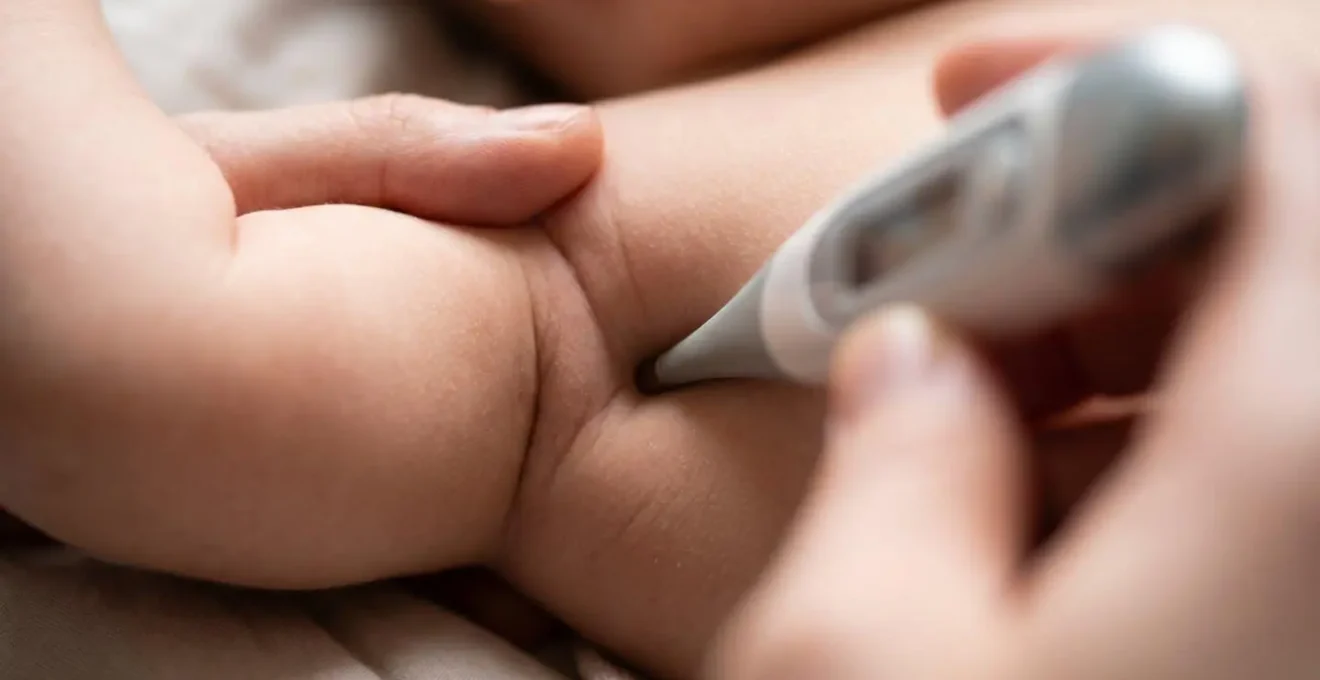
Fortunately, there is a simple and highly effective protocol recommended by the NHS to manage this. Prophylactic use of infant paracetamol has been shown to dramatically reduce the incidence and severity of fever. NHS guidance shows that with paracetamol, fewer than 1 in 5 children develop fever, compared to more than half of infants who go without it. This simple step turns a potentially worrying experience into a manageable one.
Your Paracetamol Action Plan for the MenB Jab
- Give the first dose of infant paracetamol (2.5ml of 120mg/5ml suspension) as soon as possible after the MenB vaccination.
- Administer a second dose 4 to 6 hours after the first dose.
- Give a third dose 4 to 6 hours after the second dose.
- Leave at least 4 hours between each dose and do not give more than 4 doses in any 24-hour period.
- If a fever starts or persists despite paracetamol, or lasts longer than 48 hours, contact your GP or call NHS 111 for advice.
The Nasal Flu Spray: Why Is Porcine Gelatine Used and Are There Alternatives?
The annual nasal flu vaccine (Fluenz) is offered to children because it is highly effective and avoids a needle. However, for some families, particularly those in Muslim or Jewish communities, the use of porcine gelatine in its formula can be a significant concern. It is vital to address this openly. The gelatine is there for a very specific and important reason.
Porcine gelatine is used in vaccines as a stabiliser, to ensure that the vaccine remains safe and effective during storage.
– UK Health Security Agency, Vaccines and porcine gelatine guidance
This stabilising agent ensures the live, weakened virus in the nasal spray remains viable until it’s administered, giving your child the best possible protection. Many faith leaders have issued guidance stating that its use in medicine is permissible, but this remains a personal choice for every family. The most important thing is that a concern about gelatine should not lead to a child being unprotected from flu, which can be a very serious illness in young children, sometimes leading to hospitalisation.
For parents who are not comfortable with the nasal spray, there is an excellent alternative. The injectable flu vaccine is available and does not contain porcine gelatine. While the nasal spray is often preferred for its ease of use and slightly higher efficacy in some studies, the injectable vaccine provides good, solid protection. You have the right to request this alternative. The key is to have an open conversation with your practice nurse about your concerns so they can provide the most appropriate option for your family.
The following table, based on an NHS comparative analysis, breaks down the key differences to help you make an informed decision.
| Feature | Nasal Spray (Fluenz) | Injectable Flu Vaccine |
|---|---|---|
| Administration method | Spray into each nostril | Injection into upper arm or thigh |
| Vaccine type | Live attenuated (weakened virus) | Inactivated (killed virus) |
| Efficacy in children | Often more effective in children | Standard protection |
| Contains porcine gelatine | Yes (small amount as stabiliser) | No |
| Suitable for children with severe asthma | No (not for those needing intensive care) | Yes |
| Suitable for severely immunocompromised | No | Yes |
| Pain factor | Painless | Brief needle discomfort |
| Preferred option for healthy children | Yes | Alternative if nasal spray unsuitable |
Redness vs Allergic Reaction: What Is Normal After the 1-Year Hib/MenC Jab?
The one-year vaccinations include boosters for protection against Haemophilus influenzae type b (Hib) and meningitis C. Like any injection, it’s common to see a local reaction at the injection site. For a worried parent, it can be difficult to know what’s a normal part of the immune process and what might be a sign of a more serious allergic reaction. The ability to calibrate this risk is crucial for your peace of mind.
A normal reaction is simply a sign that the immune system has been activated. When the vaccine is introduced, the body sends immune cells to the area to investigate. This process, called inflammation, is what causes the classic signs of redness, swelling, and warmth. This is a local, contained, and temporary response. It shows the vaccine is doing its job of teaching the body to recognise the threat.

An allergic reaction, particularly a severe one (anaphylaxis), is very different. It is a systemic, or whole-body, overreaction. Instead of a localised red patch, you would see symptoms appear across the body, such as widespread hives (urticaria), swelling of the face, lips or tongue, and difficulty breathing. It’s important to know that severe allergic reactions are extremely rare and almost always happen within 15 minutes of the vaccination, which is why you are asked to wait at the surgery after the appointment. Differentiating between these two is key.
Checklist: Normal Side Effect or Cause for Concern?
- NORMAL: Localised redness and swelling at the injection site (up to the size of a 50p coin) that appears within hours and resolves in 1-2 days.
- NORMAL: Warmth around the injection area, indicating a local immune response.
- NORMAL: Mild tenderness when the injection site is touched.
- CONCERNING: A widespread rash (urticaria/hives) appearing across the body, not just at the injection site.
- URGENT (15-Minute Rule): Difficulty breathing, facial swelling, or collapse within 15 minutes of vaccination are signs of anaphylaxis requiring immediate emergency care.
- SEEK ADVICE: A high fever persisting beyond 48 hours, a non-blanching rash (one that doesn’t fade when you press a glass against it), or unusual drowsiness.
Is It Ever Too Late to Start Vaccinations If You Previously Refused?
If you’ve previously decided against vaccination or have fallen significantly behind, the thought of re-engaging with the NHS can be daunting. You may feel judged or worry that it’s simply « too late. » The most important message to hear is this: you will be supported, and it is almost never too late to protect your child.
It is never too late to catch up on the vaccinations recommended in England.
– Black Country Integrated Care Board, NHS Vaccinations guidance
Your GP and practice nurse are healthcare professionals whose primary goal is your child’s health. They understand that parents can reconsider their position and will welcome your decision to move forward with vaccination. The process is not about blame; it’s about creating a practical, safe catch-up protocol. You do not need to restart the entire schedule from scratch. The nurse will simply pick up where you left off, creating a personalised plan with safe minimum intervals between doses to get your child fully protected as efficiently as possible.
This principle of catching up is a standard part of NHS immunisation policy. For certain vaccines, the window for catching up extends for many years. For example, catch-up is possible for some vaccines, like HPV and MenACWY, for which the NHS provides free catch-up up to a person’s 25th birthday. While some childhood vaccines have stricter age limits for the NHS schedule (like Rotavirus), the MMR vaccine is free at any age. The first step is always the same: book an appointment with your practice nurse to discuss a plan.
Go into the conversation proactively. A simple phrase like, « I’ve been reconsidering our position on vaccinations and I’d like to discuss a catch-up plan for my child, » is all that’s needed. This signals your intent and allows the nurse to partner with you effectively. The focus will immediately shift to the practical steps of scheduling and protection.
Can You Opt Out of the Heel Prick Test and What Are the Legal Implications?
The newborn blood spot test, commonly known as the heel prick test, is offered for all babies around day 5. Unlike vaccinations, which protect against external diseases, this is a screening test to detect rare but serious internal health conditions early. A common question is whether parents can refuse this test. The simple answer is yes, you have the right to refuse the test for your child. However, this right comes with a significant responsibility.
There are no direct legal penalties for refusing the test. However, the medical team has a profound professional and ethical duty to ensure that your refusal is fully informed. This means they must explain, in detail, the potential consequences of a missed diagnosis for each of the conditions being screened for. This is not a tactic to pressure you, but a fundamental part of patient care.
While you have the right to refuse, the medical team has a duty to ensure you understand the specific, life-altering consequences of a missed diagnosis for each of the 9 conditions.
– NHS Newborn Blood Spot Screening Programme, NHS Screening Programmes informed consent guidance
Refusing the test means accepting the risk that your child could have one of these conditions, which would then only be discovered later when symptoms have already appeared. For many of these illnesses, this means irreversible damage may have already occurred. An informed refusal involves you formally acknowledging that you have heard and understood these specific risks. The midwife will document this conversation carefully in your baby’s health records. It’s a serious decision, and the process is designed to ensure you weigh the small discomfort of the test against the life-altering benefits of early detection.
Health Visitor vs GP: Who Should You Call for Developmental Concerns?
In the early years, the roles of the Health Visitor and the GP can sometimes feel overlapping, leaving parents unsure of who is the right person to call for a particular concern. Having a clear understanding of their distinct functions can help you get the right support quickly. Think of them as two different specialists for your child’s wellbeing: one for development and one for illness.
Your Health Visitor is your primary contact for all things related to your child’s growth and development. They are experts in child development milestones, feeding, sleep, behaviour, and overall family wellbeing. They lead the Healthy Child Programme, conducting routine reviews (e.g., at 6-8 weeks and around 1 and 2 years) to check progress. You should call your Health Visitor for:
- Concerns that your child isn’t meeting milestones (e.g., not rolling over, babbling, or walking).
- Advice on feeding, weaning, or difficult sleep patterns.
- Support with your own mental health as a new parent.
- General questions about your child’s behaviour or progress.
Your General Practitioner (GP) is your first port of call for medical illness. They are experts in diagnosing and treating acute and chronic health conditions. While they have knowledge of child development, their primary role is medical. You should call your GP for:
- Any signs of acute illness: high fever, persistent cough, breathing difficulties, vomiting, or a non-blanching rash.
- Specific physical symptoms like an unusual lump, persistent pain, or skin conditions like eczema.
- When your Health Visitor has identified a developmental concern that may have a medical cause and has advised you to see a doctor for further investigation.
In short: for questions about ‘how my child is doing’, start with the Health Visitor. For concerns that ‘my child is sick’, go to the GP. They work together, and using them correctly ensures your concerns are addressed by the right expert.
Key takeaways
- The NHS vaccination schedule is timed to protect children during specific ‘windows of vulnerability’ to serious diseases.
- Common fears about vaccines (like the MMR/autism myth or MenB fevers) have been thoroughly debunked or are manageable with simple, proactive care.
- It is never too late to contact your GP about a catch-up plan; healthcare professionals are there to support, not judge, your decision to protect your child.
The NBS Heel Prick Test: What Conditions Are Actually Screened at Day 5?
The decision to accept or refuse the newborn blood spot (NBS) test becomes much clearer when you understand exactly what it’s looking for. This isn’t a vague check-up; it is a highly specific screening for a handful of rare but devastating conditions where early treatment can prevent death or severe disability. The entire principle is based on intervention before symptoms even have a chance to appear.
On day five of your baby’s life, a midwife will take a few drops of blood from their heel. This small sample is then sent off to a lab where the NHS newborn blood spot screening programme tests for 9 rare but serious conditions. Catching these illnesses in the first few days of life is a modern medical miracle that prevents untold suffering.
The conditions screened for are not easily detectable otherwise and can be grouped by their impact. Understanding what is being prevented makes the value of the test crystal clear:
- METABOLIC DISEASES: This group includes Phenylketonuria (PKU), MCADD, and three others. If undetected, these conditions prevent a baby from processing food properly, leading to a build-up of toxins that cause severe, irreversible brain damage. Early detection allows for a special diet that enables normal development.
- HORMONE DISEASES: Congenital hypothyroidism (CHT) is screened for because a lack of thyroid hormone from birth causes severely stunted growth and learning difficulties. A simple, daily hormone tablet allows the child to grow and develop just like any other.
- BLOOD DISORDERS: Sickle cell disease and cystic fibrosis (CF) are tested for. Early diagnosis of sickle cell allows for preventative antibiotics that dramatically reduce the risk of life-threatening infections. For CF, it means starting physiotherapy and treatment immediately to protect lung function and improve long-term quality of life.
- IMMUNE DISORDERS: Severe combined immunodeficiency (SCID) means a baby is born with virtually no immune system. The test allows for immediate isolation and life-saving treatment before they are exposed to a common infection that could be fatal.
Each of these nine tests represents a chance to avert a tragedy. The heel prick test is one of the most powerful preventative health measures offered by the NHS, giving children the chance of a healthy life that would have been impossible just a few generations ago.
The decision to protect your child is the most important one you can make. If you are behind on the schedule, the next logical and crucial step is to turn that intention into action. Contact your GP practice today and book an appointment with the practice nurse to create your child’s personalised catch-up plan.
Frequently Asked Questions about The NHS Vaccination Schedule
Do I have to restart the entire vaccine schedule from the beginning if my child missed several doses?
No. If the primary course has been started but not completed, you simply resume the course. There is no need to repeat doses or restart the course. Your practice nurse will create a personalised catch-up schedule with minimum intervals between doses to protect your child in the shortest time possible.
Which vaccines remain free on the NHS if I want to catch up?
MMR vaccine is free at any age. HPV vaccine is free up to your 25th birthday. MenACWY vaccine is free up to your 25th birthday. However, some vaccines like Rotavirus and MenB have age restrictions and may require private payment if the standard window is significantly missed.
Will my GP judge me for changing my mind about vaccination?
No. Healthcare professionals are there to support your decision to protect your child. Frame the conversation proactively by saying something like: ‘I’ve reconsidered my position on vaccination and I’d like to discuss a catch-up plan for my child.’ Your GP will work with you to create the safest accelerated schedule.