The relentless drive to keep children safe has paradoxically contributed to soaring anxiety; the solution is not more safety, but smarter, manageable risks.
- Risky play is a neurobiological process that calibrates a child’s internal « risk thermostat, » teaching their brain to manage uncertainty.
- Activities like climbing, using tools, and independent exploration provide essential sensory input (vestibular and proprioceptive) that regulates the nervous system and builds the foundations for focus and emotional control.
Recommendation: Shift your mindset from eliminating all risks to identifying and facilitating ‘healthy risks’—those your child can see, assess, and learn from.
We live in a paradox. In our relentless pursuit of safety, wrapping our children in layers of supervision and sanitized environments, we have inadvertently cultivated a new, more insidious danger: a generation struggling with unprecedented levels of anxiety. We’ve removed the scraped knees but introduced a fragile spirit. We’ve built taller fences but failed to build internal resilience. Parents are caught in a bind, instinctively wanting to protect their children while watching them become fearful of the unknown. Many believe the answer lies in more structured activities or therapy, but these often treat the symptoms, not the cause.
What if the solution is not to add more layers of protection, but to strategically peel a few back? The antidote to this modern anxiety isn’t found in a sterile playroom, but up a tree, near a campfire, or at the edge of their own perceived limits. This is the power of risky play. This isn’t about encouraging recklessness; it’s about understanding that a child’s brain is not a passive vessel to be filled, but a dynamic system that must be wired through experience. Letting your child engage with manageable risks is a fundamental neurobiological process. It is how they calibrate their internal ‘risk thermostat,’ learning to differentiate a genuine hazard from a thrilling challenge. It’s how they build, not just muscles, but the very brain architecture required to face a world full of uncertainty with confidence instead of fear.
This article will guide you, the caring but concerned parent, through this counter-intuitive landscape. We will dismantle the fear surrounding risky play and replace it with a liberating, science-backed framework. We will explore how to teach risk assessment, introduce real tools safely, understand the sensory science behind spinning and swinging, and empower you to become a facilitator of bravery, not just a manager of safety.
To help you navigate this essential topic, this article breaks down the core components of healthy risky play. From the practicalities of tree climbing to the deep science of sensory integration, you’ll find a clear path to raising a more resilient and less anxious child.
Summary: A Parent’s Guide to Risky Play and Anxiety Reduction
- Tree Climbing: How to Teach Your Child to Check Branches Before Weighting?
- Fire Pits: At What Age Can a Child Strike a Match Safely?
- Whittling and Hammers: Introducing Real Tools to Under-7s?
- Play Fighting: When Does It Cross the Line into Aggression?
- Roaming Radius: How Far Should a 10-Year-Old Be Allowed to Cycle?
- Trampolining vs Swimming: Which Sport Actually Builds Bone Density?
- Spinning and Swinging: How to Stimulate Balance Without Causing Nausea?
- DIY Sensory Circuits: Regulating Energy Levels Before School Run
Tree Climbing: How to Teach Your Child to Check Branches Before Weighting?
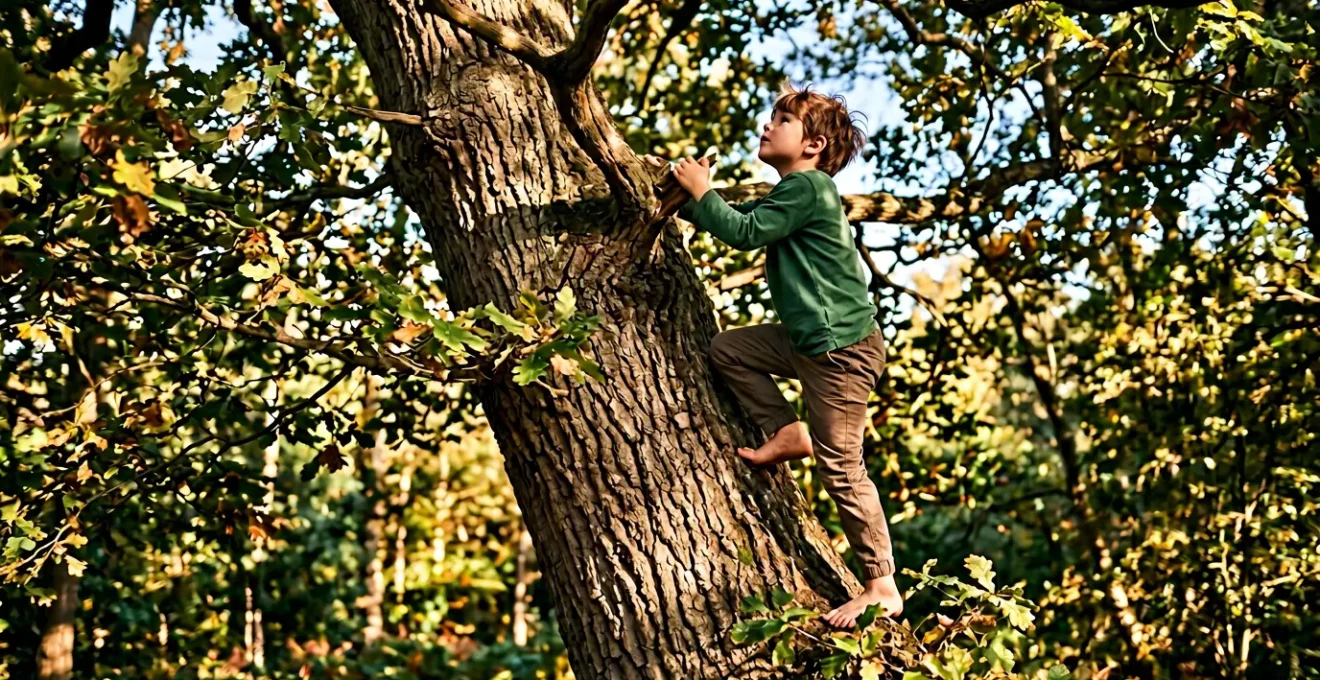
The iconic image of a child in a tree is the very definition of risky play for many. Our first instinct is to shout, « Be careful! Get down from there! » But in doing so, we rob them of a vital lesson in physics, biology, and self-assessment. The goal is not to prevent climbing but to transform your child from a reckless climber into a savvy arborist who understands their environment. This begins with a crucial mindset shift: you are not a safety director; you are a risk-assessment coach. Your role is to help them learn to see the world as a series of problems to be evaluated and solved.
The first step is teaching the difference between a risk and a hazard. A risk is something a child can see, evaluate, and choose to engage with—like a high branch. A hazard is a hidden danger they can’t assess, like a rotten, unstable branch. As play specialist Catherine Sewell notes in a video on the topic, « A hazard is something that the child can’t see for themselves that’s in their environment that could cause serious injury. » So, instead of a blanket ban, you create a simple rule: « Always test before you trust. » Teach them the « three-point contact » rule (always have three limbs on the tree) and how to check a branch by shaking it and listening for a solid sound versus a dry crackle. This process of active evaluation is where the magic happens. A mixed-method study of over 1,600 parents confirmed tree climbing is a relatively safe activity, finding that an overwhelming 82% of parents agreed the benefits of tree climbing outweigh potential injuries. The child isn’t just climbing a tree; they’re learning to trust their judgment, read their environment, and manage their own safety—skills far more valuable than a life lived on the ground.
By empowering them with knowledge, you replace your own anxiety with their growing competence, allowing them to climb higher not just in trees, but in life.
Fire Pits: At What Age Can a Child Strike a Match Safely?
Few things trigger a parent’s alarm bells like a child’s fascination with fire. Yet, this primal element offers one of the most profound lessons in respect, responsibility, and the laws of nature. Banning all interaction with fire only increases its mystique and the likelihood of unsafe experimentation. The liberating approach is to reframe fire from a forbidden danger into a tool that demands and teaches respect. This is not about a specific age, but about developmental readiness and a gradual, supervised education. The question isn’t *when* they can strike a match, but *how* you can build a scaffold of knowledge so that when they do, it’s an act of responsibility, not rebellion.
This education can be broken down into clear, age-appropriate stages. For toddlers, the rule is simple: « Don’t touch. Find a grown-up. » For school-aged children, it evolves into a duty of care: they become the ‘hazard remover’ for younger siblings, bringing any found matches to an adult. Only when a child demonstrates consistent impulse control, an understanding of cause and effect, and the fine motor skills to strike a match away from their body are they ready for supervised practice. This isn’t about handing them a lighter; it’s about a shared, purposeful ritual—lighting a campfire, a birthday candle—that is framed by clear rules: a bucket of water nearby, a designated fire pit, and 100% adult supervision. This structured approach demystifies fire and transforms it into a lesson in personal power and control.

This process of gradual exposure and education is the key. The goal is to have so many positive, controlled experiences with fire that the temptation for unsupervised, dangerous play simply vanishes. You are replacing a fearful prohibition with a powerful, respectful competence.
It’s in the warm glow of a campfire they helped build that children learn one of life’s most important lessons: with great power comes the absolute need for great responsibility.
Whittling and Hammers: Introducing Real Tools to Under-7s?
The idea of handing a five-year-old a hammer or a pocketknife can feel like a line that should never be crossed. We give them plastic tools, believing we are keeping them safe. But what if we are actually starving their developing brains of crucial input? Using real tools is not just about building a birdhouse; it’s about building a brain. The first few years of life are a period of explosive neurological growth. According to Harvard’s Center on the Developing Child, the brain forms more than 1 million new neural connections per second in these early stages. These connections are not formed by watching screens or playing with toys that do the work for them. They are forged through tangible, sensory-rich, problem-solving experiences.
When a child uses a real hammer, they are getting a masterclass in physics and feedback. They learn about force, momentum, and accuracy. They have to adjust their grip, their aim, and the power of their swing. A plastic hammer offers none ofthis rich feedback. It’s the difference between a conversation and a monologue. Similarly, whittling a stick with a small, supervised knife teaches focus, fine motor control, and three-dimensional thinking in a way no app ever could. This isn’t about letting them run wild with dangerous objects. It’s about creating a « bubble of safety » for a « bubble of risk. » This means one-on-one supervision, a proper sitting position (e.g., the « blood bubble » space around them), and clear, simple rules like « always cut away from your body. »
The brain’s basic architecture is constructed through an ongoing process that begins before birth and continues into adulthood. Simple neural connections and skills develop first, followed by more complex circuits and skills. The connections that form early provide either a strong or weak foundation for the connections that form later.
– Center on the Developing Child, Harvard University – Brain Architecture
By denying them real tools, we are not just denying them a skill; we are denying their brains the complex, tangible challenges they crave for optimal development. We are building a weaker foundation for all future learning. Providing these experiences is an act of profound trust that tells a child, « I believe you are capable and responsible. »
That belief, in itself, is one of the most powerful tools you can ever give them.
Play Fighting: When Does It Cross the Line into Aggression?
Rough-and-tumble play, or play fighting, is one of the most misunderstood and often-shunned forms of play. To the untrained adult eye, it looks like pure aggression—a prelude to a real fight. We rush in to separate them, telling them to « use their words. » But in doing so, we interrupt a critical social negotiation. For many children, especially those who process the world physically, roughhousing is not the opposite of communication; it *is* communication. It’s a dynamic, physical dialogue about boundaries, consent, power, and empathy. The key is teaching them how to keep it playful.
The line between play fighting and real aggression is crossed when the joy disappears. The hallmarks of healthy roughhousing are laughter, smiling, and taking turns being the « powerful » one. Crucially, it involves « meta-communication »—the signals that say « this is still a game. » This can be a goofy grin, an exaggerated sound effect, or a willingness to pause and check in. A child who is truly engaged in play fighting will often stop if their partner yelps in genuine pain. A child who has crossed into aggression will not. Your role is not to be a referee who stops the game, but a coach who teaches them the rules: establish a « tap-out » word, check in with your partner (« Are you still having fun? »), and most importantly, respect a « no. »
This type of play is a powerful antidote to anxiety, which is often a fear of the unknown and a feeling of powerlessness. In a world where recent estimates show that 1 in 5 children now have mental health problems (a stark increase from pre-pandemic figures), providing outlets for physical agency is more critical than ever. As researcher Helen F. Dodd, PhD, points out:
Risky play supports children’s learning about uncertainty, physiological arousal and effective coping. Children aged 2 to 4 years who spend more time engaged in risky play have lower levels of internalising problems such as anxiety and depression, and higher positive mood.
– Helen F. Dodd, PhD, Encyclopedia on Early Childhood Development – Risky Play and Mental Health
Play fighting allows children to experience high arousal and physical stress in a contained, safe way, teaching their nervous systems that they can handle big feelings and physical intensity, and then return to a state of calm. It’s a dress rehearsal for life’s real conflicts.
By allowing it, you are not raising an aggressive child; you are raising a child who is literate in the complex language of human physicality and emotion.
Roaming Radius: How Far Should a 10-Year-Old Be Allowed to Cycle?
There has been a quiet, devastating decline in children’s independent mobility. Where once children roamed their neighborhoods freely, today they are often chauffeured from one supervised activity to another. This loss of freedom is not just a nostalgic lament; it has profound consequences for their development and mental health. Allowing a child to roam—to walk or cycle to a friend’s house, the local park, or a corner store alone—is a powerful statement of trust. More importantly, it is an essential ingredient for developing what is known as « environmental literacy. »
Environmental literacy is the ability to navigate your world confidently and competently. It’s knowing the shortcuts, recognizing landmarks, understanding traffic patterns, and knowing which neighbors have friendly dogs. It cannot be taught in a classroom or from the passenger seat of a car. It is learned by moving through space on one’s own terms, making small navigational decisions, and occasionally getting a little bit lost and finding your way back. Determining the « right » roaming radius for a ten-year-old is less about a specific distance and more about a process of gradual expansion based on their demonstrated competence and knowledge of their local area.
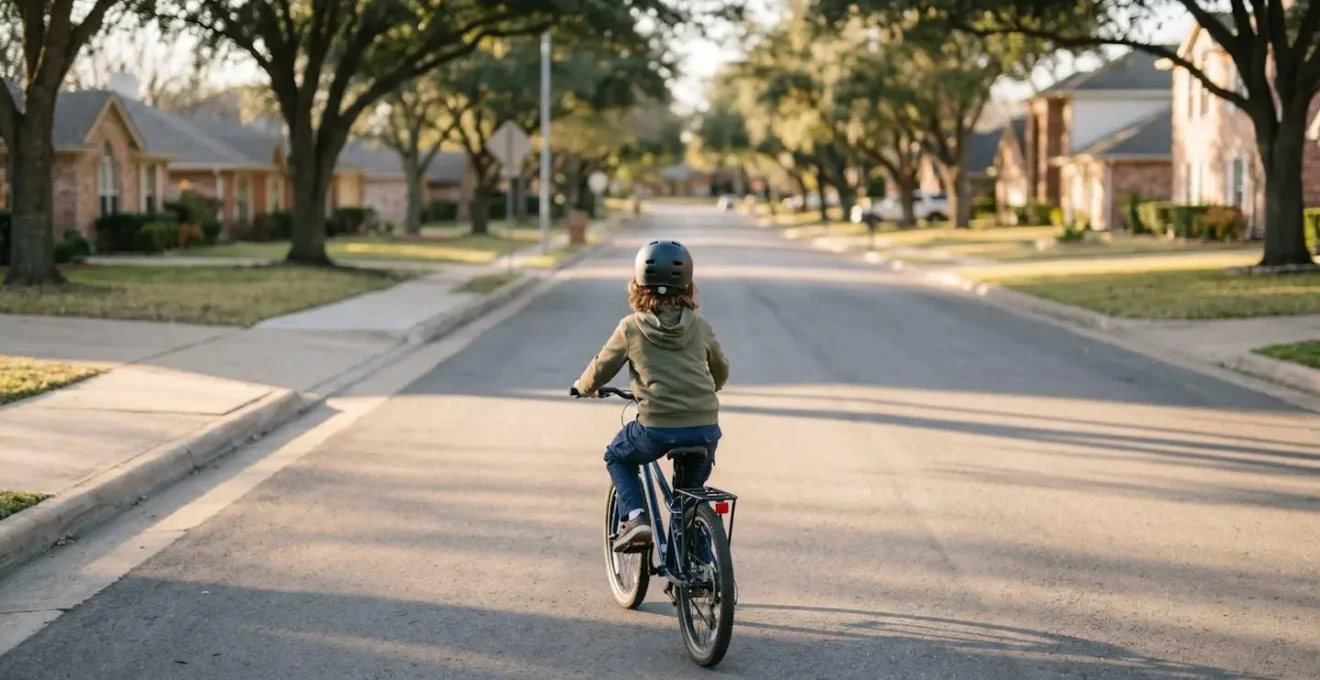
Start small: a trip to the end of the block and back. Then, to a specific friend’s house on the next street over. Each successful trip earns a slightly larger radius. This is not about casting them out into the unknown; it’s a structured, scaffolded release of responsibility. The anxiety this provokes in parents is real, but the consequences of keeping them tethered are worse.
The Societal Cost of Lost Independence
Research led by Mariana Brussoni has documented how our increasingly risk-averse culture has drastically reduced children’s opportunities for independence. This societal shift is directly linked to negative mental health outcomes as children become young adults. Studies show that those who had fewer opportunities for independent mobility and risky play exhibit higher rates of anxiety and depression, and an impaired ability to function independently in adulthood. In response, the Canadian Paediatric Society now officially encourages pediatricians to advocate for risky play as a vital strategy to address these growing health challenges, recognizing that a childhood without freedom has a long-term cost.
By granting them the freedom to roam, you are giving them the gift of their own world—a world they will learn to navigate with skill, confidence, and a deep sense of belonging.
Trampolining vs Swimming: Which Sport Actually Builds Bone Density?
When choosing physical activities for our children, we often focus on cardiovascular health or skill acquisition. But for a growing body, the mechanical forces of an activity play a critical role in development, particularly in building a strong skeleton and a well-regulated nervous system. Trampolining and swimming present a fascinating contrast. Both are excellent forms of exercise, but they offer radically different benefits for anxiety, sensory processing, and physical development. Understanding this difference allows you to choose an activity that truly meets your child’s specific needs.
The key distinction is weight-bearing. Swimming is a fantastic low-impact sport, but its buoyancy means it does little to promote bone density. Trampolining, on the other hand, is a high-impact, weight-bearing activity. Every jump sends vertical loading forces through the bones and joints, signaling the body to build more bone mass. This is crucial for lifelong skeletal health. But the benefits go far deeper. The rhythmic, powerful up-and-down motion of jumping provides intense proprioceptive input—the sense of where your body is in space. For many children, particularly those who are sensory-seeking or feel « disorganized, » this input is incredibly grounding and calming. It’s like a reset button for the nervous system.
Swimming provides a different, but equally valuable, type of sensory input. The constant, even pressure of the water on the entire body provides deep-pressure input, which is uniquely calming and dampening for children who are easily overstimulated or sensitive to sound. As the Canadian Paediatric Society suggests, thinking of play as a health strategy allows us to make more targeted choices.
This comparative table breaks down the distinct developmental benefits, allowing you to tailor activities to your child’s specific sensory and emotional profile.
| Factor | Trampolining | Swimming |
|---|---|---|
| Bone Density Impact | High-impact, weight-bearing activity that builds bone density through vertical loading forces | Low-impact, non-weight-bearing; minimal bone density benefits |
| Sensory Input Type | Powerful rhythmic vertical proprioceptive input; highly organizing and grounding for nervous system | Consistent deep-pressure sensory input; uniquely calming and dampening for overstimulated children |
| Risk Type | Physical misjudgment, learning to control body in air, spatial awareness challenges | Primal risk: breath control, deep water, survival skills |
| Best For (Anxiety Profile) | Sensory-seeking, under-responsive children who need intense physical outlet to feel calm | Easily overstimulated, sound-sensitive children who benefit from quiet, low-sensory-noise environment |
| Motor Planning Feedback | Instant, jarring feedback on motor planning decisions | Requires attunement to subtle signals of breath and buoyancy |
| Risky Play Category | Play with high speed and heights | Play near dangerous elements (water) |
By seeing activities through a sensory lens, you move beyond simply « keeping them busy » and begin to provide the precise inputs their brains and bodies need to thrive.
Spinning and Swinging: How to Stimulate Balance Without Causing Nausea?
The playground swing and roundabout are not just for fun; they are powerful neurological tools. The spinning, swinging, and rocking motions directly stimulate the vestibular system, the sensory organ located in our inner ear. This system is the brain’s master regulator, controlling not only balance and spatial orientation but also profoundly influencing our sense of safety, our ability to focus, and our emotional state. A well-regulated vestibular system is essential for everything from sitting still in class to reading a line of text without losing your place. Yet, for many children, and the adults who care for them, there’s a fear of overdoing it—of that fine line between exhilarating fun and dizzying nausea.
The secret to harnessing the power of vestibular stimulation without causing distress is to be methodical and child-led. The « Start-Stop-Settle » technique is a simple but profoundly effective way to do this. Instead of relentless, continuous spinning, you introduce movement in short, controlled bursts. Start with gentle spinning for 10-15 seconds, then stop completely. This pause is critical. It allows the fluid in the inner ear to settle, preventing the sensory system from becoming overwhelmed. During this « settle » phase, you observe the child. Are they smiling and asking for more? Or do they look dazed and disoriented? Their response is your guide. You only resume when they show they are regulated and ready.
The vestibular system, located in the inner ear, doesn’t just control balance, but also directly informs the brain’s sense of safety, focus, and emotional state. A well-regulated vestibular system allows the eyes to track smoothly, which is essential for reading and writing.
– Occupational therapy research consensus
Furthermore, not all movement is created equal. Smooth, linear swinging (back and forth) is generally organizing and calming for the nervous system—perfect for a child who needs to wind down. Rotational movement (spinning) is alerting and energizing, ideal for a sluggish child who needs to « wake up » their brain before a task like homework. By understanding these principles, you can transform a simple swing set into a sophisticated tool for emotional and cognitive regulation.
You become a DJ for their nervous system, expertly choosing the right rhythm to help them find their balance, both physically and emotionally.
Key Takeaways
- Childhood anxiety is often exacerbated by over-protection; managed risk is a powerful antidote.
- Risky play is a neurological necessity that teaches the brain to handle uncertainty, building resilience.
- Parents should act as ‘risk coaches,’ not ‘safety directors,’ teaching children to assess their environment rather than avoiding all challenges.
DIY Sensory Circuits: Regulating Energy Levels Before School Run
The morning rush can be a chaotic, stressful time for any family. For a child with an under-regulated nervous system, it can be a daily crisis. They might be sluggish and unable to get moving, or hyperactive and bouncing off the walls, making the simple act of getting dressed and out the door feel like a battle. A DIY sensory circuit is a powerful, five-minute solution to this daily struggle. It’s a short sequence of physical activities designed to give the brain and body exactly the right input to wake up, get organized, and start the day in a calm, focused state. The beauty of this approach is that it’s not another chore; it’s a game that sets the tone for a successful day. The fact that early childhood development research shows that up to 70% of human brain development occurs in the first 3 years through play underscores the power of these seemingly simple games.
A successful circuit follows a simple « Alert-Organize-Calm » framework. You start with activities to « Alert » or wake up the brain, like jumping jacks or animal walks. Next, you introduce an « Organize » activity that requires motor planning and coordination, like crawling through a furniture obstacle course or balancing on a line of pillows. This challenges the brain to connect with the body. Finally, and most importantly, you finish with a « Calm » activity that provides proprioceptive « heavy work » to ground and regulate the nervous system. This could be pushing a heavy laundry basket, doing wall pushes, or simply a series of tight, deep-pressure hugs. The entire sequence takes less time than it takes to argue about finding a missing shoe.
The true genius of the sensory circuit is its adaptability. For a child who is sluggish in the morning, you’ll spend more time on the « Alert » activities. For a child who is anxious or hyperactive, you’ll emphasize the « Calm, » heavy work activities. By observing your child, you can create a personalized routine that meets their unique sensory needs, transforming the morning from a source of conflict into a moment of connection and regulation.
Your Action Plan: Designing a Morning Sensory Circuit
- Assess the Need: Is your child typically sluggish (needs more ‘Alert’) or hyperactive/anxious (needs more ‘Calm’) in the morning? This will determine your focus.
- Gather Your Tools: Inventory simple household items: pillows for balancing, a laundry basket for pushing, a heavy blanket for rolling, a clear wall space for pushes. No special equipment is needed.
- Build the Sequence: Create a 3-step sequence based on the ‘Alert-Organize-Calm’ framework. Write it down on a whiteboard or chart so the child knows the routine. Example: 1. 10 Star Jumps (Alert), 2. Crawl under the dining table (Organize), 3. 5 slow wall pushes (Calm).
- Test and Observe: Run the circuit for a week. Does it help? Is one activity causing more dysregulation? Be ready to swap activities out. If balancing on pillows is too hard, try walking on a line of tape instead.
- Integrate and Empower: Once you have a working circuit, make it a non-negotiable part of the morning routine. Empower the child by letting them choose between two different ‘Alert’ activities to give them a sense of ownership.
Start your family’s day not with a rush and a shout, but with a jump, a crawl, and a hug—a recipe for a calm and focused morning.