
Contrary to common belief, a child’s inattention or learning struggles are often not behavioral issues but symptoms of undetected hearing loss from glue ear, a « cognitive saboteur » that masquerades as other problems.
- Mild, fluctuating hearing loss dramatically increases a child’s cognitive load, making it harder to learn and focus in a classroom setting.
- Seemingly visual or behavioral signs, like squinting, head tilting, or social withdrawal, are often sensory compensation or masking strategies to cope with an inability to hear clearly.
Recommendation: Trust your parental instinct. If you observe these behaviors, don’t just wait for the next school check; advocate for a comprehensive audiological evaluation to rule out hearing loss as the root cause.
Is your child suddenly turning up the TV volume? Do you feel they are ignoring you when you call their name? Before you attribute it to « selective hearing » or a behavioral phase, consider a far more common, and often invisible, culprit: Otitis Media with Effusion, better known as glue ear. It’s not a dramatic, painful ear infection, but a quiet buildup of sticky fluid in the middle ear. This condition is so prevalent that, according to the UK Academy of Medical Royal Colleges evidence base, 4 out of 5 children (80%) will have had an episode of glue ear by age 10. While often temporary, its impact on a developing brain can be profound and is frequently misunderstood.
The common advice is to « watch and wait, » and it’s true that many cases resolve on their own. However, during those weeks or months of fluctuating hearing loss, a child’s brain is working overtime. The real issue isn’t just the muffled sound; it’s the way this condition acts as a great masquerader. This article will not simply list the common symptoms. Instead, we will explore how glue ear actively presents as other, more noticeable issues—from vision problems and behavioral withdrawal to difficulties with mathematics and language. We will uncover why you cannot rely on routine school screenings and what you, as a parent, can do to become a « sensory detective » for your child. We will delve into medical options, classroom support, and practical strategies to mitigate the cognitive load this condition creates.
This guide is structured to help you connect the dots between your child’s seemingly unrelated behaviors and the possibility of a hidden hearing issue. By understanding how these challenges are linked, you can better advocate for your child’s needs both at home and in the classroom.
Summary: Why Glue Ear’s Impact Goes Far Beyond Hearing
- Grommets or Hearing Aids: Which Option Is Best for Persistent Glue Ear?
- Squinting or Head Tilting: Subtle Signs Your Child Needs Glasses Now
- Why You Can’t Rely on the School Nurse Vision Check for Astigmatism?
- Hearing but Not Understanding: Could It Be Auditory Processing Disorder?
- FM Systems in Classrooms: How to Get Funding for Hearing Support?
- Hiding in the Back: How to Spot if Your Child Is Masking Learning Gaps?
- Mixing Languages: Why ‘Spanglish’ Is a Sign of Proficiency, Not Confusion?
- Homework Wars: How to Support Maths Mastery Without Confusing Your Child
Grommets or Hearing Aids: Which Option Is Best for Persistent Glue Ear?
The first line of defense against glue ear is typically « watchful waiting. » This approach is often successful; according to clinical guidance from the National Deaf Children’s Society, 50 to 90% of cases clear up within 3 months without intervention. However, when the condition persists, it can significantly impact speech development and learning. At this point, your audiologist or ENT specialist will discuss two primary options: grommets or hearing aids. This isn’t a choice between a « better » or « worse » solution, but about finding the right tool for your child’s specific situation and timeline.
Grommets are tiny ventilation tubes inserted into the eardrum during a short surgical procedure under general anesthesia. They allow air to enter the middle ear, equalizing pressure and allowing fluid to drain away. Hearing aids, on the other hand, are a non-surgical option. They work by amplifying sound to a level that can overcome the muffling effect of the fluid. They are worn daily and removed at night, serving as a bridge to restore hearing while the body naturally resolves the glue ear. The decision involves weighing the pros and cons of a one-time procedure versus a daily-use device.
To help clarify the decision-making process, the following table breaks down the key factors for each intervention. It compares the nature of the procedure, its duration, potential risks, and the type of lifestyle impact you can expect.
| Factor | Grommets (Surgical) | Hearing Aids (Non-Surgical) |
|---|---|---|
| Intervention Type | Surgical procedure under general anesthesia | Non-invasive amplification device |
| Duration of Effect | 6-12 months (grommets fall out naturally) | Ongoing use until glue ear resolves |
| Hearing Improvement | Mean improvement of 9 dB at 6 months, 6 dB at 12 months | Amplifies sound to compensate for hearing loss |
| Lifestyle Impact | Requires anesthesia; water precautions for swimming | Daily wear required; social adjustment needed |
| Risks/Challenges | 10% discharge risk; 1-2% permanent perforation; 20% need re-insertion | Requires consistent use; parental effort for younger children; potential stigma |
| Best for | Persistent bilateral glue ear after 3 months watchful waiting | Bridge solution during watchful waiting or between grommet surgeries |
Ultimately, the best choice is a collaborative decision made with your medical team. It will depend on the persistence and severity of the glue ear, your child’s age, and your family’s comfort level with each approach. Both are proven methods to restore the hearing crucial for a child’s development.
Squinting or Head Tilting: Subtle Signs Your Child Needs Glasses Now
When a parent sees their child squinting, tilting their head, or sitting too close to the TV, the immediate assumption is a vision problem. You book an appointment with an optometrist, which is a sensible step. But what if the eye check comes back clear? This is a critical diagnostic moment where many parents get stuck. The problem might not be with what your child is *seeing*, but a desperate attempt to compensate for what they are *not hearing*. This is a classic example of sensory compensation.
A child with fluctuating hearing loss from glue ear must expend enormous mental energy to follow a conversation. They quickly learn, often unconsciously, that visual cues are more reliable than muffled auditory signals. They start to watch lips, study facial expressions, and focus intensely on the speaker’s body language. The squinting and head tilting you observe are not necessarily to see better, but to focus their entire cognitive apparatus on decoding the visual information associated with speech. The head tilt might be an attempt to angle their ‘better’ ear towards the sound, a subtle adjustment that speaks volumes about their struggle.

As the illustration shows, this posture is a subconscious effort to optimize their remaining sensory input. They are not being defiant or inattentive; they are working harder than anyone else in the room just to keep up. Recognizing these behaviors as potential auditory red flags, rather than purely visual ones, is the key to getting them the right help.
Your action plan: Cross-Sensory Diagnostic Checklist
- Document instances of squinting or head tilting specifically during auditory challenges (when teacher speaks from across room, in noisy environments, during group discussions).
- Note whether visual behaviors increase in correlation with background noise levels or distance from speaker.
- Observe if child angles their ‘better ear’ toward sound source while simultaneously focusing visual attention on speaker’s lips.
- Record frequency of asking ‘what?’ or ‘huh?’ combined with increased visual concentration (staring intently at speaker).
- Present documented patterns to pediatrician and explicitly ask: ‘Could these visual compensatory behaviors be a reaction to an underlying hearing problem rather than vision issues alone?’
If you see these signs, you are not just seeing a child who might need glasses. You are potentially seeing a child who is using their vision as a lifeline because their hearing is failing them. It’s a crucial distinction that can change the entire course of support.
Why You Can’t Rely on the School Nurse Vision Check for Astigmatism?
The title of this section may seem specific to vision, but its real message is a warning against the false security of isolated, routine school screenings. A school nurse’s vision check is designed to catch common refractive errors. An audiologist’s hearing screening checks for the ability to hear tones at specific frequencies. Both are valuable, but they operate in silos. They are not designed to detect the complex, intertwined way that a mild hearing problem can manifest, creating a cascade of learning difficulties that can be easily misdiagnosed.
The fundamental flaw is that these checks miss the concept of cumulative cognitive load. A child’s brain has a finite amount of processing power. When a child has undetected glue ear, a significant portion of that power is diverted to the simple task of decoding muffled sound. This is exhausting. Now, add the normal challenges of a classroom: background noise, a teacher moving around the room, complex instructions. The cognitive resources are depleted almost instantly. The child isn’t lazy or unfocused; their « mental battery » is draining at twice the speed of their peers.
This isn’t just theory. The interaction between environmental factors and mild disability has been rigorously studied, highlighting how minor issues can multiply their negative impact.
Case Study: The Multiplier Effect of Cognitive Load
A landmark 2014 study published in PLOS One examined 1,155 children and found that the cognitive development of children from homes with lower levels of cognitive stimulation is particularly susceptible to the effects of glue ear and hearing loss. The research demonstrated an interaction effect: children experiencing both glue ear/hearing loss AND limited home cognitive stimulation performed significantly worse on IQ tests at ages 4 and 8 compared to children with only one risk factor. This illustrates how minor, undetected hearing loss combined with other challenges doesn’t simply add up—it multiplies the cognitive load, leading to much faster attention collapse and learning fatigue in classroom settings.
Relying solely on a school nurse’s check is like checking a single component of a car’s engine when the problem is a leak in the fuel line affecting the entire system. You need a holistic view. You need to look for the patterns of struggle, not just a single, isolated test result.
Hearing but Not Understanding: Could It Be Auditory Processing Disorder?
Perhaps the most confusing scenario for a parent is when their child passes a standard hearing test, yet still struggles to follow conversations, especially in noisy places. The child can « hear » the sound, but the meaning gets lost somewhere between the ear and the brain. They might complain that people are mumbling, frequently ask « what? », or respond inappropriately to questions. This is the hallmark of a potential Auditory Processing Disorder (APD), a condition where the brain doesn’t correctly process the sounds the ear hears.
While APD can have various causes, there is a growing body of evidence linking it to a history of early childhood ear infections and glue ear. The chronic, fluctuating nature of glue ear during the critical period of brain development for language can disrupt the establishment of clear neural pathways for sound. The brain essentially learns to process a distorted, inconsistent signal. Even after the glue ear resolves, these inefficient processing pathways can remain.
The child isn’t just hearing a muffled world; their brain struggles to distinguish between similar sounds, follow multi-step instructions, or filter out a teacher’s voice from classroom chatter. A recent study powerfully illustrates this long-term impact of early hearing challenges on brain development.
Children with several ear infections before three years of age had smaller vocabularies and a harder time matching similar sounding words than children with few or no ear infections. They also had difficulty detecting changes in sounds, a sign of problems in their brain’s auditory processing centers.
– Dr. Susan Nittrouer, University of Florida research on chronic ear infections and language development
This finding is critical. Research from the University of Florida on 117 children showed that children with several ear infections before age 3 had smaller vocabularies and difficulty matching similar-sounding words. This isn’t a hearing problem in the traditional sense; it’s a processing problem rooted in early auditory experiences. The distinction is vital because the interventions are different, focusing on brain training and coping strategies rather than simple amplification.
If your child seems to hear but not comprehend, it’s time to shift your investigation. You’re not just asking « How loud is the sound? » but « How clearly is my child’s brain receiving the message? » A specialized APD evaluation by an audiologist is the necessary next step to get a definitive answer.
FM Systems in Classrooms: How to Get Funding for Hearing Support?
For a child with any degree of hearing loss, a classroom is an auditory battlefield. The teacher’s voice competes with coughing, shuffling papers, hallway noise, and the hum of the ventilation system. This « signal-to-noise ratio » is often poor, and for a child with glue ear, it can be devastating. According to the Hearing Loss Association of America, even mild hearing loss can cause a child to miss as much as 50% of classroom discussion. They aren’t just missing a few words; they are missing half of their education. This is where assistive listening technology, particularly a personal FM/Roger system, becomes essential, not optional.
An FM system is like a one-way radio. The teacher wears a small microphone, and their voice is transmitted directly to a receiver connected to the child’s hearing aid, cochlear implant, or a discreet earpiece. It cuts through the background noise, delivering the teacher’s voice with pristine clarity, as if they were speaking directly into the child’s ear. This single piece of technology can be the difference between academic failure and success. However, schools can sometimes be resistant due to cost or lack of understanding. As a parent, you are your child’s most important advocate, and you have legal rights to secure this support.
Securing funding and implementation through an Individualized Education Program (IEP) or 504 Plan requires a strategic approach. You must be prepared, persistent, and precise in your requests. The following steps outline a parent’s toolkit for successfully advocating for this crucial technology.
- Request a formal evaluation in writing: Use specific language stating you are requesting an assistive technology evaluation to determine if an FM system is needed to provide equal access to the curriculum.
- Frame it as a classroom-wide benefit: During the IEP meeting, emphasize that improving the signal-to-noise ratio benefits all students and reduces teacher vocal strain. It’s a universal design benefit, not just a single accommodation.
- Counter the ‘incompatibility’ argument: If the school claims the technology is incompatible with your child’s current hearing aids, cite their legal obligation. The school must provide compatible equipment, not use an incomplete setup as a reason for denial.
- Demand specificity in the IEP: Ensure the plan names the device type (e.g., ‘personal FM system’), who is responsible for its maintenance, and the protocol for when it breaks. Vague language is unenforceable.
- Follow up on compliance: Once approved, connect with each teacher to ensure consistent daily use. The most common point of failure is the device sitting unused on a teacher’s desk.
Remember, this is not about asking for an advantage for your child; it’s about demanding access. An FM system levels the playing field, allowing your child’s intellect and curiosity to shine through, unhindered by the barrier of classroom noise.
Hiding in the Back: How to Spot if Your Child Is Masking Learning Gaps?
A child who is quiet, doesn’t raise their hand, and seems to « daydream » in the back of the classroom is often labeled as shy, unmotivated, or even defiant. But often, this withdrawal is not a personality trait; it is an exhausting, full-time job. It is a sophisticated coping strategy known as masking. Children with undiagnosed hearing loss quickly learn that participating is a high-risk activity. Guessing the wrong answer is embarrassing. Constantly asking « what? » is frustrating for them and the teacher. So, they develop an alternative: they disappear.
They become expert observers, glancing at a classmate’s paper not to cheat, but to figure out which page they’re supposed to be on. They nod and smile during group discussions when they haven’t understood a single word. They choose the seat in the back corner, not because they’re antisocial, but because it’s the lowest-pressure environment. These are not acts of defiance; they are acts of self-preservation. The cognitive energy required to pretend to follow along is immense, leaving no resources for actual learning.
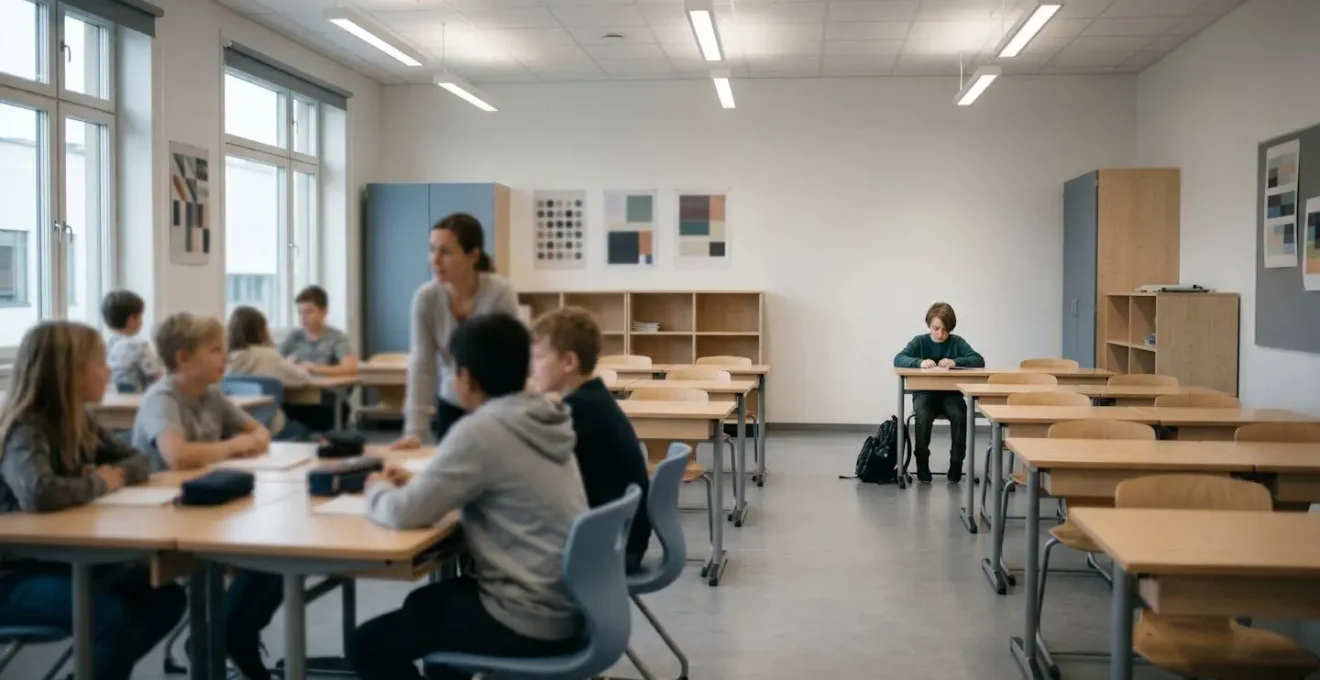
This behavior is one of the most common ways that glue ear goes undetected for months or even years, with its effects being tragically misattributed to the child’s character or ability.
Case Study: Misinterpreting Coping as Behavior
Educational research documented in NHS guidance reveals that glue ear quite commonly goes unnoticed, with behavior changes mistaken for a child being naughty or just not doing as they are told. Children develop sophisticated masking strategies: glancing at a neighbor’s paper to copy what they should be doing, nodding along in agreement when they haven’t heard, and avoiding participation to reduce social risk. These compensatory behaviors are not cheating—they are less mentally taxing and socially risky than constantly admitting ‘I can’t hear.’ Teachers report fluctuating behavioral changes including poor attention, difficulty following instructions, and social withdrawal. The NHS emphasizes that these are classic masking patterns, not behavioral problems, and require hearing assessment rather than disciplinary intervention.
When you see a child hiding in the back, look closer. You may not be seeing a problem child, but a smart, resilient child who has developed an ingenious but ultimately damaging strategy to survive an academic environment they cannot access.
Mixing Languages: Why ‘Spanglish’ Is a Sign of Proficiency, Not Confusion?
For bilingual families, a child mixing languages or seeming to lag in one language can be a source of anxiety. It’s a common fear, often fueled by well-meaning but misguided advice, that raising a child with two languages will confuse them. In reality, code-switching (mixing languages) is a sign of linguistic sophistication. However, there is a critical exception that all parents and educators must be aware of: when what appears to be a language development issue is actually another masquerade for hearing loss.
Language is built on the ability to perceive subtle differences between sounds (phonemes). Sounds like ‘s’, ‘f’, ‘th’ are high-frequency and soft, making them the first casualties of the muffled hearing caused by glue ear. A child who cannot clearly hear the difference between ‘cat’ and ‘cap’ in English will also struggle with similar phonetic distinctions in another language. Their vocabulary will be smaller in both languages because they are not receiving the clear auditory input needed to build it. They aren’t confused by two languages; they are being failed by one set of ears.
Before any teacher or therapist ever suggests « dropping a language to reduce confusion, » a comprehensive hearing evaluation is non-negotiable. It is crucial to differentiate between normal bilingual development and the red flags of a hearing-related language delay.
- Red Flag 1: Phonetic Sound Errors in BOTH Languages. A child consistently misses subtle sounds (like ‘s’ or ‘th’) across both languages. This points to hearing loss, not language confusion.
- Red Flag 2: Difficulty with Similar-Sounding Words in BOTH Languages. The struggle to differentiate words like ‘cat’/’cap’ in English and ‘casa’/’caza’ in Spanish indicates an auditory processing issue.
- Red Flag 3: Smaller Vocabulary in BOTH Languages. A significant vocabulary lag compared to peers in both languages, rather than a temporary lag in one, is a strong sign of a hearing-related delay.
- Normal Bilingual Development: The child may mix grammar but demonstrates age-appropriate sound discrimination and perception in both languages.
Never let an unconfirmed suspicion of language confusion lead to the abandonment of the precious gift of bilingualism. Always rule out a physical barrier to hearing first. More often than not, the problem isn’t too many languages, but too little sound getting through.
Key takeaways
- Glue ear is not just a minor inconvenience; its fluctuating nature creates a massive cognitive load that directly impedes learning.
- Behavioral and visual signs like inattention, withdrawal, and squinting are often not the root problem but are sophisticated compensation and masking strategies for an underlying hearing issue.
- Routine school screenings are insufficient as they fail to detect the cumulative, cross-sensory impact of mild hearing loss. A holistic view is essential.
Homework Wars: How to Support Maths Mastery Without Confusing Your Child
The nightly battle over homework can be a major source of family stress. For a child with glue ear, this is especially true for subjects like mathematics. We often think of math as a visual subject, but it is deeply rooted in language and auditory processing. Instructions are given verbally (« Find the perimeter »), concepts are explained through spoken words, and even mental math relies on an « internal auditory loop » to hold numbers and operations in mind.
For a child struggling to hear, the homework war starts with a fundamental disadvantage. The similar-sounding nature of many math terms (‘sum’ vs ‘some’, ‘eight’ vs ‘ate’, ‘factor’ vs ‘after’) can create immense confusion. The effort of simply trying to hear the instructions correctly drains the cognitive resources they need to solve the actual problem. This can lead to frustration, avoidance, and the mistaken belief that they are « bad at math. » The problem isn’t their mathematical ability; it’s their access to the information.
As a parent, trying to help can sometimes make it worse if you’re not aware of this auditory barrier. A simple shift in your approach can transform homework from a battle into a collaborative success. The key is to create a multi-sensory learning environment that doesn’t rely solely on hearing. The « Hear-See-Do » method is a powerful framework for this.
- HEAR: When giving an instruction, speak clearly while facing your child. Ensure they confirm they’ve heard correctly before moving on.
- SEE: Immediately reinforce the auditory instruction with a visual. Write down the key vocabulary word (‘perimeter’) or the problem itself.
- DO: Connect the concept to a physical action. Have them trace the shape with their finger while saying ‘perimeter’ or manipulate blocks to represent an equation.
- Address Ambiguity: Be hyper-aware of similar-sounding words. Always provide visual confirmation when using them.
- Support Mental Math: Allow the use of visual aids like a number line or writing down the problem, even for tasks designated as ‘mental math’. Their internal auditory loop may be compromised, so providing an external, visual one is a critical support.
By supporting all of your child’s senses during homework time, you’re not giving them the answers. You’re giving them what they truly need: fair and equal access to the question.