Blog
Engaging in creative activities is a fundamental pillar of child development. Far beyond simply producing a pretty picture to hang on the refrigerator, art serves as a crucial language through which children process their emotions, develop fine motor skills, and make sense of the world around them. When a child picks up a paintbrush or a piece of cardboard, they are not just playing; they are actively problem-solving, experimenting with cause and effect, and building self-confidence.
Navigating the world of children’s art can sometimes feel overwhelming for parents and educators. From managing the inevitable mess and figuring out which glue actually works on recycled plastics, to finding guilt-free ways to store mountains of paper, the practicalities of fostering creativity require thoughtful strategies. This comprehensive overview explores the philosophy of childhood creativity, examines various traditional and modern mediums, and provides actionable solutions for managing the artistic output.
The Philosophy of Art: Process Over Product
One of the most transformative shifts in facilitating children’s art is moving away from a focus on the final masterpiece and embracing the act of creation itself. When adults focus too heavily on what the finished piece should look like, they inadvertently stifle a child’s natural curiosity and willingness to take risks.
Why the Mess Matters More Than the Masterpiece
To understand a child’s approach to art, it is helpful to use the analogy of a scientist in a laboratory. For a young child, mixing all the paint colors together until they turn into a muddy brown is not a failure; it is vital sensory exploration. They are testing hypotheses about physics, texture, and color theory. Praising the mess—or rather, praising the intense focus and experimentation that caused the mess—validates the child’s developmental work. The goal is to nurture a creator, not an assembly line worker.
Shifting How We Praise
Adults naturally want to encourage children, but generic phrases like « thatisbeautiful » focus entirely on the product. To foster intrinsic motivation and critical thinking, try adjusting your feedback using these progressive steps:
- Observe objectively: State what you see without judgment (e.g., « Inoticeyouusedalotofcircularmotionshere. »).
- Ask open-ended questions: Encourage the child to articulate their thought process (e.g., « Canyoutellmeaboutthissectionofyourpainting? »).
- Validate the effort: Focus on their dedication and problem-solving (e.g., « Youworkedreallyhardonfiguringouthowtobalancethoseblocks. »).
Sustainable and Accessible Materials
Fostering artistic skills does not require expensive, pre-packaged kits. In fact, open-ended materials often provide a richer canvas for the imagination, allowing children to dictate the direction of their play rather than following a predetermined set of instructions.
Cardboard as a Foundation for Creativity
Cardboard is arguably the most versatile and valuable material in a child’s creative arsenal. A simple cardboard box can transform into a spaceship, a puppet theater, or a complex architectural model. Working with cardboard encourages spatial awareness and structural engineering skills, offering several distinct advantages:
- It is highly accessible and cost-effective, reducing the fear of « wasting » materials.
- It supports large-scale, immersive creation that engages the whole body.
- It provides a rigid base suitable for painting, cutting, and structural manipulation.
The Mechanics of Junk Modelling
Junk modelling, the practice of creating sculptures from recycled household materials, is a fantastic exercise in resourcefulness. However, it comes with specific mechanical challenges. For instance, standard school glue (PVA) notoriously fails to adhere to plastic bottles because the plastic is non-porous and flexible. To successfully construct stable recycled sculptures, consider these alternative bonding methods:
- Mechanical fasteners: Use string, rubber bands, or brass brads to physically tie or pin items together.
- Double-sided tape: A strong, thick double-sided tape bonds instantly to plastic and cardboard without the frustration of drying time.
- Low-temperature glue guns: For older children under strict supervision, low-temp hot glue provides the immediate structural hold required for irregular shapes.
Embracing Alternative Mediums: Nature and Technology
Creativity is not confined to paper and paint. Expanding the definition of art to include both the natural world and the digital landscape provides children with a broader vocabulary for self-expression.
Ephemeral Art and Mindful Connection
Creating art outdoors using natural elements like leaves, stones, twigs, and petals introduces the concept of ephemeral art. Constructing a nature mandala on the forest floor is a deeply mindful activity. Because this art cannot be framed or taken home, it teaches a valuable lesson in non-attachment. Children learn to find joy entirely in the present moment of creation, understanding that a sudden gust of wind might dismantle their work, and that impermanence is part of the beauty.
Digital Canvas: Navigating Tablet Art
As technology becomes integrated into daily life, digital drawing applications offer a unique and legitimate medium for artistic expression. Modern tablet apps can remarkably mimic the physics of real painting, allowing children to experiment with watercolor blending or oil paint texture without the logistical setup and cleanup. This builds essential digital literacy and refines fine motor control. While it should not replace tactile experiences, tablet art is an excellent supplementary tool, particularly useful for travel or environments where messy play is impractical.
Artwork Management: Preserving Memories Without the Clutter
A thriving creative environment inevitably leads to a significant logistical challenge: how to handle the sheer volume of artwork produced. Throwing away a child’s creation can induce guilt, but keeping every single sketch is unsustainable.
Strategies for Culling and Keeping
Managing the « artbin » requires a system that honors the child’s effort while maintaining order in the home. Implementing a structured curation process helps families preserve the most meaningful pieces:
- The Immediate Gallery: Display new artwork prominently on a dedicated bulletin board or a string with clothespins for a week. This provides immediate validation.
- The Holding Zone: Move older displayed pieces into a temporary, concealed box. Distance and time make it easier to objectively evaluate the pieces later.
- The Curation Stage: At the end of a season, involve the child in selecting a few representative masterpieces to keep permanently.
- The Digital Archive: Photograph or scan the remaining pieces before recycling the physical copies. This preserves the memory without sacrificing physical space.
By establishing these rhythms, you can cultivate a home environment that consistently encourages uninhibited creation, celebrates the messy, beautiful process of learning, and thoughtfully curates a manageable archive of a child’s artistic journey.

Kitchen Science: Teaching STEM Concepts with Baking Soda and Vinegar
The classic baking soda and vinegar volcano is a missed opportunity; the real lesson isn’t the fizz, but the scientific method it unlocks. Reframing simple reactions as multi-stage experiments teaches…
Lire la suite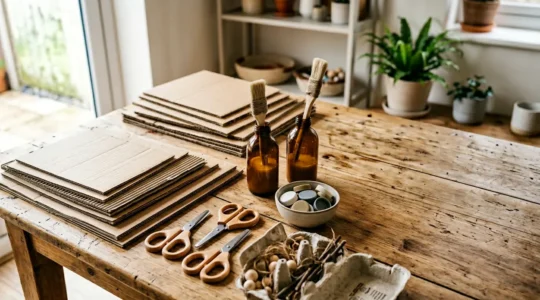
Cardboard Creativity: Fostering Art Skills Without Expensive Kits
Contrary to marketing pressure, you don’t need expensive, single-use kits to raise a creative child; in fact, they often hinder true artistic development. Budget constraints can be reframed as a…
Lire la suite